
 By Norman van den Wildenberg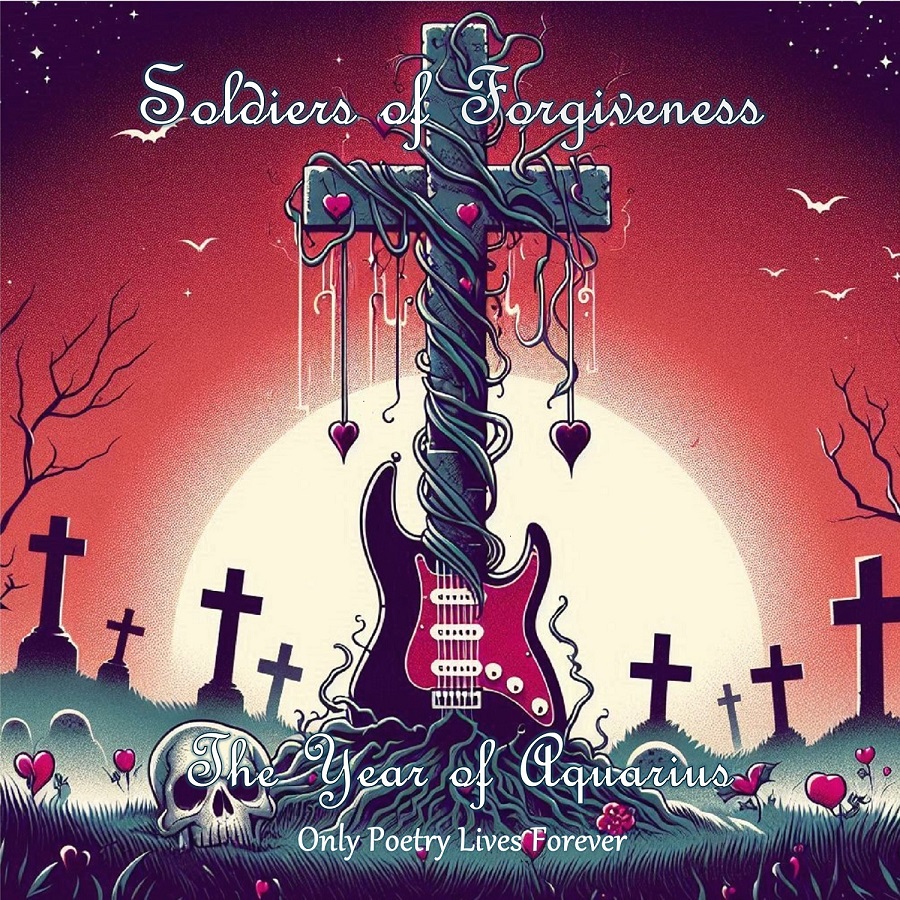
Soldiers of Forgiveness have delivered an ambitious third chapter in their layered musical epic with “The Year of Aquarius: Only Poetry Lives Forever”. This international collective, presenting themselves as bards from another time, continues with this release their conceptual story in which three eternal forces, LOVE, HATE and TIME, play an epic board game with humanity as their pawns. Following “The Year of Capricorn” and “The Year of Virgo”, this album marks the quarter-final of a planned twelve-round cycle.
The origin of this project lies in founder Mikko Viljamaa’s frustration with the increasing division in the world around 2020. What began as a bedroom project has grown into an international production with professional metal musicians from the United States, Argentina, Venezuela, Italy and Portugal. The result is a sound that is difficult to capture in one genre. The band describes their style as metal written by bards from another time who had heard random fragments of metal from different decades, without knowledge of subgenres or production expectations.
The album opens with the dreamy “Dystopian Dreams” and then takes the listener into a five-part poetic cycle that tells the story of Josef, a boy who only wanted to be a poet but grew to become the leader of the outcasts. The narrative is supported by Scott Tunnix’s impressive narrative voice in “Interlude: The Poet” and other interludes. The tension between Josef’s heroic mission and his lost innocence forms the emotional core of the album.
Musically, “The Year of Aquarius” offers a broad palette. Songs like “Evil That Men Do”, “Unquenchable Fire” and “Never Die” showcase the power of the international ensemble, with Leonel Silva and Alessandro Medri dividing the male vocals across different tracks. Hilda Maria Viljamaa, as Aquarius, adds an extra dimension with her female vocals. The instrumentation is rich and layered, with Manú Lopez on guitar and bass, Hugo Alexandre on drums, and Ezequiel Marcovecchio reinforcing the theatrical character with his violins.
The absolute highlight is the twelve-minute “Part IV: Where The Madness Reigns”, in which Tessa Viljamaa, with her piano compositions and waltz sections, creates an enchanting atmosphere that blurs the line between bombastic metal and chamber music. This track demonstrates the collective’s courage to take stylistic risks and proves that their approach is more than just eclectic bombast. “Part V: Only Poetry Lives Forever” then offers an emotional climax that brings together the album’s central themes.
The production by Mikko Viljamaa, with co-mixing and co-mastering by Vincenzo Avallone, breathes a childlike enthusiasm that works surprisingly well. The orchestrations are lush without becoming overwhelming, and the attention to dynamics ensures that the more intimate moments like “Autumn Winds” and “The Dance of The Owls” have breathing room between the heavier passages. The comparisons to Savatage and a darker version of Trans-Siberian Orchestra are not unfounded, although Soldiers of Forgiveness have forged their own identity.
Yet not everything is perfect. The eclectic approach can sometimes lead to a lack of focus, with some songs being stylistically far apart. The short “Part III: Welcome To The Madness”, for example, feels somewhat underdeveloped next to the epic tracks that surround it. For listeners who prefer the polished production of mainstream symphonic metal bands, the sometimes rough production may come across as amateurish. These traits are most noticeable on the ‘oddball’ pieces “Part III: Welcome To The Madness” and “The Dance of the Owls”, which are performed by Bedlam Beat, the house band of Madness, and are intentionally produced in a different style; the project has even hinted at a possible full Bedlam Beat album. Additionally, the complex story requires considerable investment from the listener to fully appreciate.
What makes the album special, however, is the sincerity with which Soldiers of Forgiveness tell their story. The social engagement, with all proceeds being donated to charities of the listener’s choice, gives extra weight to the thematic exploration of love, hate and forgiveness. The fact that forty to fifty per cent of their audience are not metal fans underscores the crossover potential of their work.
Soldiers of Forgiveness have proven with this third instalment that their GAME is more than a gimmick. It is a mature attempt to use metal as a medium for storytelling and social reflection, executed with sufficient musical skill to appeal to both metal lovers and a broader audience. (8/10) (Self Produced)
 Maxazine South Africa