
 By Jan Vranken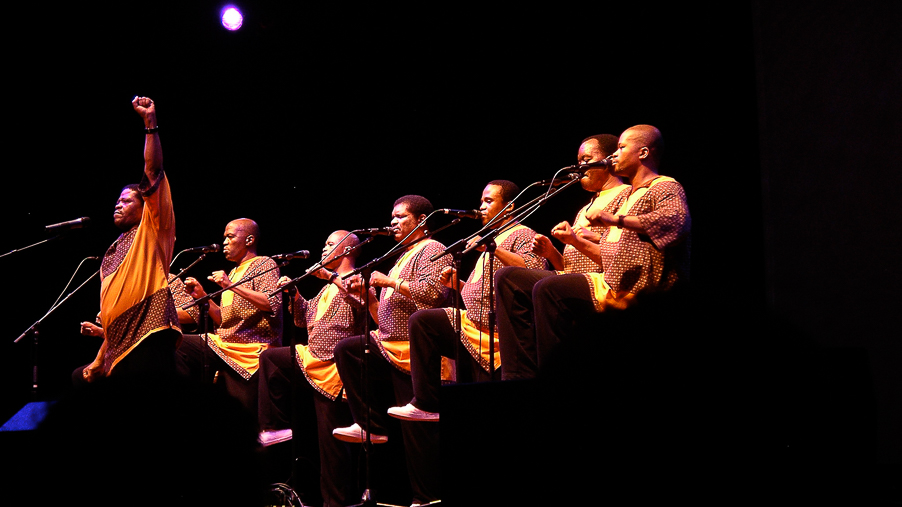
Albert Mazibuko, co-founder and longest-serving member of the legendary South African isicathamiya group Ladysmith Black Mambazo, died on Easter Sunday, 5 April 2026, at the age of 77. The group confirmed his death on Monday via social media. Mdletshe Albert Mazibuko was born in Ladysmith, KwaZulu-Natal, as the second child in a family of six. His father, Mashumi Mazibuko, believed in education, but the reality of South Africa in the 1950s forced the young Albert to work on a farm from the age of eight. Before music set him free, he spent years as a manual labourer, including in an asbestos factory.
Yet music was in him from an early age. In 1957, when he was just nine, Albert founded his own isicathamiya choir: the Zulu Motos ‘SS Choir’, based in Ladysmith. Twelve years later, that calling would change his life forever.
In 1969, his cousin Joseph Shabalala asked him to join a new, more ambitious ensemble. Shabalala had previously led a group called Ezimnyama ‘The Blacks’, but was only satisfied when he found the core he was looking for in 1969. Albert joined the group as a tenor, alongside his younger brother Milton as alto. From that moment on, the Mazibuko family became inseparably linked with Ladysmith Black Mambazo.
Albert was described by Shabalala himself as his right-hand man. He was present at the first recordings for the Gallo label in 1973, at the debut album “Amabutho”, which became the first record by a black artist in South Africa to achieve gold status, and at the breakthrough onto the international stage.
Tragedy struck both the group and the Mazibuko family. In 1980, Albert’s brother Milton died. In 1991, Headman Shabalala, brother of Joseph, was shot dead by a white security guard, reportedly for racist reasons. In 2002, Joseph’s wife Nellie, was murdered. In 2004, brother Ben Shabalala was also shot.
With each loss, Albert was the one who kept the group together. When, after the death of Headman Shabalala, voices called for the group to stop, it was Albert who said that music would give them strength. In an interview, he once said, ‘Whenever we hear bad news, we come together and sing and pray. Music lifts you out of your body to a place that knows no sorrow.’ Ladysmith Black Mambazo’s international breakthrough came in 1986, when Paul Simon featured the group on his album “Graceland”, with contributions to songs such as “Diamonds on the Soles of Her Shoes” and “Homeless”. Albert was there and would go on to become the group’s regular spokesperson for the international press over the following decades.
Albert always placed the highlight of his career in Oslo in 1993, when Nelson Mandela asked Ladysmith Black Mambazo to accompany him at the Nobel Peace Prize ceremony. Mandela, who had listened to the group’s music while in prison, called them ‘the cultural ambassadors of South Africa’. Albert later recalled how Mandela had stood up during an earlier concert in Johannesburg, performed his famous Madiba dance, and shaken their hands, saying, ‘Keep it up, your music was a great inspiration to me in prison.’ In total, Ladysmith Black Mambazo won five Grammy Awards and received nineteen nominations, more than any world music group in the history of the recording industry. The group collaborated with artists including Dolly Parton, Stevie Wonder, Sarah McLachlan, Emmylou Harris and Josh Groban, appeared in films such as “Moonwalker” by Michael Jackson and “Coming to America” with Eddie Murphy, and performed for the British royal family at the Royal Albert Hall.
When Joseph Shabalala retired in 2014 and handed leadership to his sons Thulani, Sibongiseni and Thamsanqa, Albert became the only remaining singer from the original 1969 line-up. He carried that role with grace. Asked whether he had ever considered retiring himself, he replied dryly, ‘Retire from this beautiful journey? Do you want me in the grave?’ When Shabalala died in February 2020, Albert was the one who addressed the world from Los Angeles, midway through an American tour. He said he had last seen Shabalala six months earlier and that they had not spoken a word, but had sung the entire time, ‘because that is what we always did’. In May 2025, after 55 years, Albert bid a final farewell to Ladysmith Black Mambazo. His younger brother Abednego remained as the last Mazibuko in the group.
The group described Albert in their tribute as ‘a saint’, ‘kind to the core’ and ‘the best of the best’. He never tired of telling the story of the group and its mission to spread ‘peace, love and harmony’ around the world, for as long as people were willing to listen. Albert Mazibuko is survived by his wife, Lillian Dlomo Mazibuko, whom he married in 1976, and his brother Abednego. Details of the funeral and memorial service have not yet been announced. With his death, the last direct link to the origins of one of Africa’s most important musical ensembles disappears. Ladysmith Black Mambazo sang their way from the streets of Ladysmith to the Nobel Prize, from the mines of KwaZulu-Natal to Carnegie Hall. Albert Mazibuko was there all along. For fifty-five years, he was not only the voice, but also the memory and the conscience of a group that showed the world that singing is stronger than apartheid, and that harmony, in every sense of the word, has the final say.
 Bianca Fernandes
  William Brown
  Norman van den Wildenberg