
 By Jan Vranken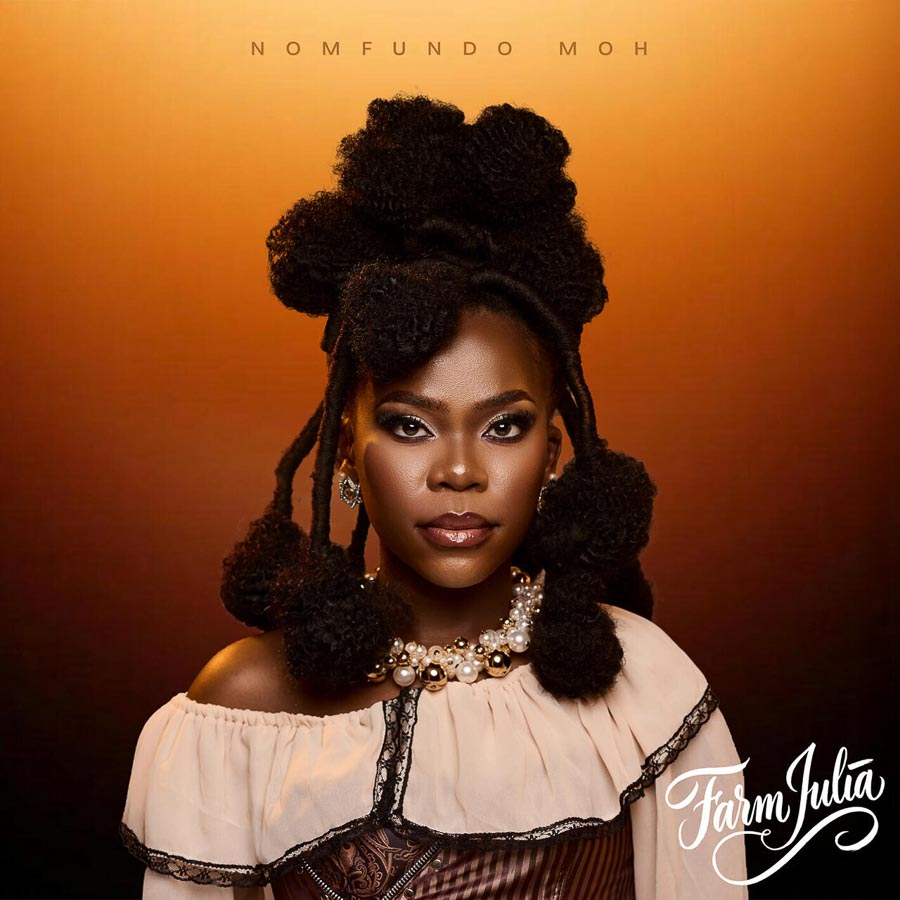
Nomfundo Moh, the 25-year-old South African singer from Ndwendwe in KwaZulu-Natal, releases her fourth studio album, “Farm Julia”, via Sound African Recordings.
Some singers convince you with technique. Some singers convince you with personality. And then some voices convince you with something almost impossible to define, the kind of effortlessness you only find in people who do not realise how exceptional they are. Nomfundo Moh belongs to the latter category. She sings as if it comes naturally to her, as if that timbre and the precise placement of every note is something everyone has. It is anything but. “Farm Julia” is not an album for people who want noise. It is an album for people who know how to listen. Thirteen tracks, built on soft acoustic guitar melodies, restrained percussion and production that centres the voice rather than surrounding it with unnecessary gloss. The themes are those of a woman looking back at where she comes from: home (“Ikhaya”), honour (“Thobela”), loss (“Isifo”), and the right to succeed (“Uzophumelela”, the lead single that already set the expectations). The language is Zulu; the intention is universal.
Anyone searching their musical memory for a point of comparison will quickly arrive at Khadja Nin. The Burundian singer who, in 1996, surprised the world with “Sambolera”, combining African rhythms, western pop and jazz arrangements. That melancholic clarity of voice, those seemingly simple yet carefully woven vocal structures: “Farm Julia” breathes the same air. Not as a copy, but as an echo. A reminder of what African pop music can be when it does not try to sound European or American, but simply itself. That is nowhere more audible than on “Malume”. The vocal arrangement is the kind of work that makes arrangers stay awake at night out of jealousy: layers that leave space, harmonies that do not fill but accentuate, a structure that seems to breathe. It is the finest moment on an album full of fine moments. “Singenanto” is another category. With De Rose, Makhosi and Una Rams, Moh delivers the perfect pop song for a lazy afternoon: effortless, infectious, the sum of four voices that know exactly when to step back. You may not understand a word, but it does something beneath the diaphragm that music sometimes does.
Nomfundo Moh was born in 2000. Nelson Mandela died in December 2013, when she was thirteen. She grew up in South Africa without apartheid, and also without the man who embodied the end of apartheid. Mandela is, for her generation, the so-called born free generation, not a political leader but something closer to a grandfather to everyone: a moral compass, a historical figure, a presence known from books and monuments but never encountered in person. That makes “Farm Julia” more than a homecoming album. It is a document of what that freedom has delivered for a young black girl who grew up on a farm in KwaZulu-Natal, went to university, signed a record deal and now releases her fourth album at the age of twenty-five. The title refers to a real fan from her following, an ordinary woman from the countryside. By placing her name above an album, Moh makes a political gesture that she would probably not call political, but it is no less so.
Khadja Nin once dedicated an album to Mandela as a living hero. Nomfundo Moh makes music in an era in which that hero exists only as memory. What her generation does with that freedom can be heard on “Farm Julia”. It sounds promising. “Farm Julia” is the best album by Nomfundo Moh to date: mature, coherent, and carried by a voice that has not yet found its limits. (8/10) (Sound African Recordings / Sony Music Entertainment Africa)
 Bianca Fernandes
  William Brown