
 By Bart van de Sande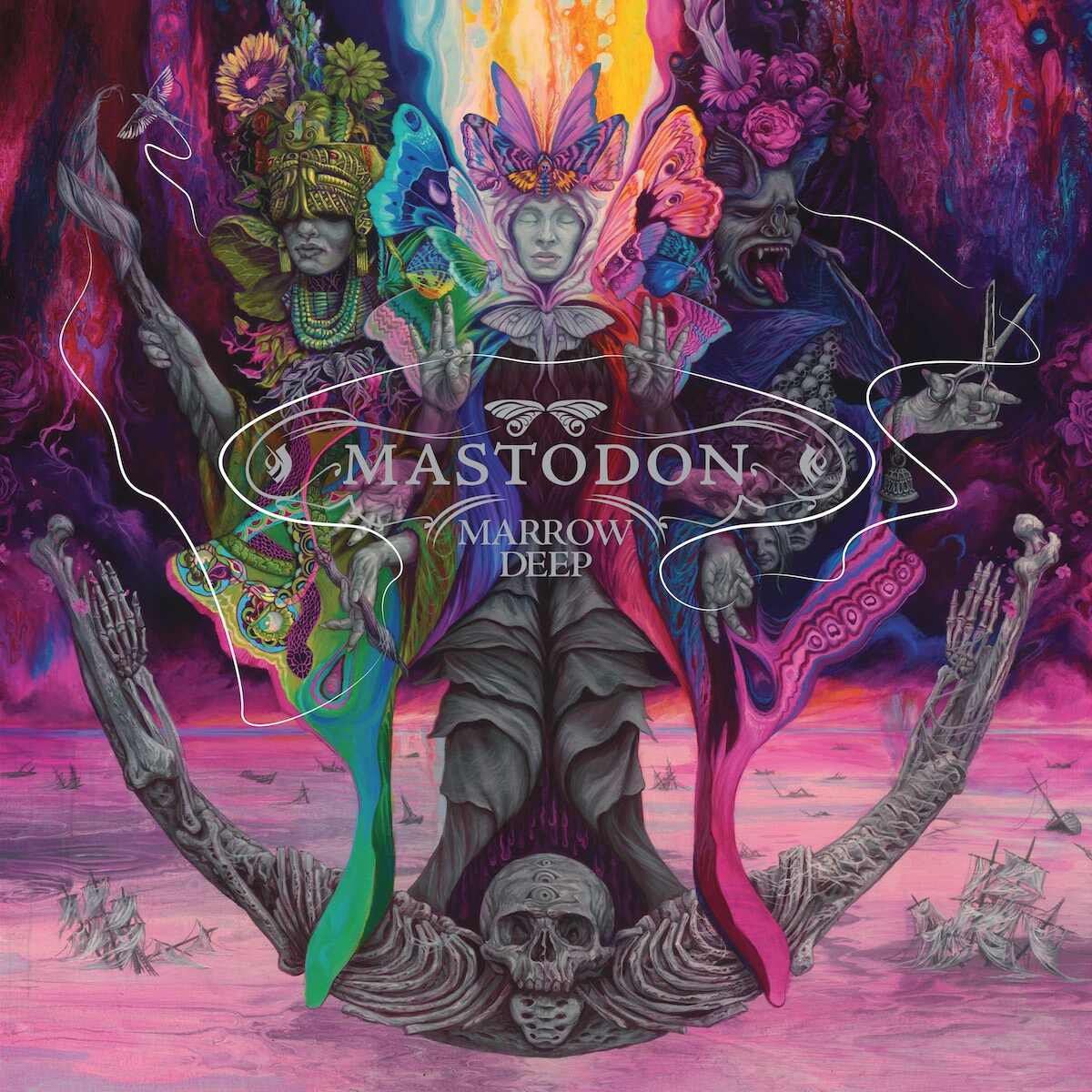
A mastodon is a colossal thick-skinned herbivore with tusks and knobbly teeth. A fine name for a band. The story goes that the unfortunately deceased guitarist Brent Hinds looked at a Bantha skull tattoo that guitarist Bill Kelliher had on his arm and thought that Mastodon would be a fine name for the band. Luckily, earlier ideas such as Abra Cadaver, Savage Hamper or Rabid Taxi might perhaps have resonated somewhat less widely.
With “Marrow Deep”, Mastodon now arrives with its ninth studio album. This time without Brent Hinds, who had left the band shortly beforehand due to friction, usage and a difference in vision. His departure inevitably took on much greater significance following his death in 2025. After 25 years, a band also becomes a second family, especially when the line-up has remained largely stable throughout those years.
This is also reflected in the album’s third track, “Your Ghost Again”. The title alone says a lot. The memory of Brent seems to be constantly present in the background, while drummer Brann Dailor’s energy regularly gives the track extra drive. It is a song in which the sense of loss is not expressed through grand gestures, but is above all palpable in the music.
But as befits Mastodon, the album also starts big and powerful with “Barbarian’s Blood”, a savage opening, with tempo changes that Mastodon by now seems almost to have a patent on. Tight, solid and performed with flair. It is immediately clear that the band has no intention of easing off after 25 years.
With “Marrow Deep”, twenty years after “Blood Mountain”, there is also a renewed collaboration with Josh Homme of Queens of the Stone Age on the song “Snakes for Dinner”. It also provides a more prominent introduction to the guitarist who has replaced Brent Hinds in Mastodon: Nick Johnston. Johnston makes his mark with a strong solo and shows that he has not only been brought in as Hinds’ replacement, but can also genuinely add something to the band. He also receives co-writing credits for the song.
The variety in talent and individual contributions is a strong point of the band in any case. Bassist Troy Sanders provides the deepest and roughest vocals in the songs, whereas drummer Brann Dailor takes care of the more melodic parts. Guitarist Bill Kelliher generally contributes to the backing vocals. These different voices and musical roles ensure that Mastodon never relies entirely on one face or one sound.
The musicianship of all the band members also ensures that there are many ideas, dynamics and changes within the songs. As a result, an enormous amount can happen in a single Mastodon song. That is one of the band’s strengths, but at the same time also a small caveat when it comes to “Marrow Deep”.
It can sometimes contribute to there seeming to be little room to breathe. If you blink for a moment, you may well have missed an important passage. Listening to Mastodon requires focus to take in everything the band members have put into it. That may make “Marrow Deep” not the most accessible album for a fleeting listen. On the other hand, anyone who enjoys an album packed with nuances and details will not be disappointed by “Marrow Deep”. In fact, repeated listening reveals something new each time.
Particularly further towards the end, Mastodon shows that it is not yet a fossil. “The Vanishing”, with a wonderful bass contribution from Geezer Butler and guest vocals from Gojira’s Joe Duplantier, is a fine example of this. The song once again gives the album a different colour. The closing track “The Three Fates” also provides a swirling finish.
“Marrow Deep” is therefore not an album on which Mastodon completely reinvents itself. The band’s recognisable signature is too strongly present for that. But perhaps after 25 years, that is not necessary at all. The band still sounds like Mastodon, while the arrival of Nick Johnston and the events surrounding Brent Hinds do indeed add a new layer to the sound and, above all, to the meaning of the album. Mastodon is not extinct yet and still matters. (8/10) (Loma Vista)
 Daniel Harris
  Maxazine South Africa